
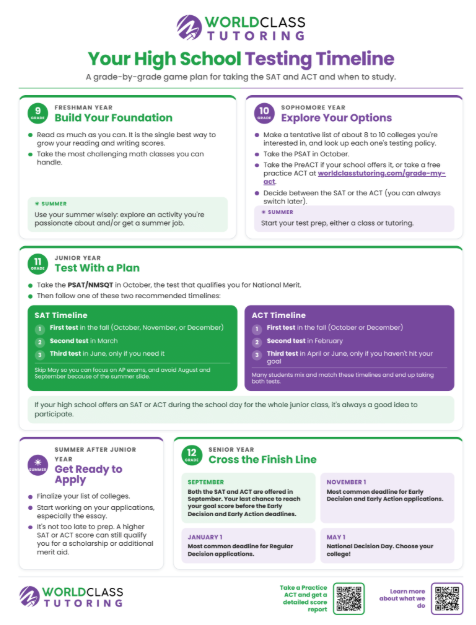
When should you take the SAT and ACT? Here’s our grade-by-grade guide for families.
When talking with parents, I often hear confusion over when to take the SAT or ACT. They worry that their child will miss a testing window, or that they will realize the moment to start test prep has quietly come and gone. I understand that feeling, and I want to take it off your plate. When a family has a clear plan for standardized testing, everything downstream gets calmer. Your teen studies at the right moments, retakes only when it actually helps, and heads into senior year with scores already in hand instead of scrambling to catch up.
This testing timeline maps out what to focus on each year of high school, from ninth grade all the way through college decisions. You can see the full plan in the graphic below, and there is a printable version for those who prefer paper. Here is what each year looks like, and why each step earns its place.
A printable PDF of the timeline is available to download here.
Freshman Year: Build Your Foundation
Ninth grade is not about testing at all, and that is exactly the point. The two skills that matter most on the SAT and ACT are strong reading and strong math, so this is the year to build both. Encourage your teen to read as much as they can, because reading is the single best way to grow the vocabulary and comprehension that both tests reward. At the same time, they should take the most challenging math classes they can handle. By the time they take the SAT and ACT they should have completed Algebra 1, Geometry, and Algebra 2.
Summer counts too. A freshman who spends the summer exploring an activity they care about or working a summer job is building the kind of story that colleges love to see.
Sophomore Year: Explore Your Options
Tenth grade is when the planning begins in earnest. I encourage families to sit down together and make a tentative list of about eight to ten colleges your teen finds interesting. This early list is not a commitment, just a first step. The next step is to look up each college’s testing policy, which can vary from college to college and even from year to year. Whether your child even needs to take a test is a surprisingly tricky question, so start this research early.
The honest answer these days is that it depends on the schools. More than eight in ten four-year colleges are still test-optional or test-free, so many students do have a choice. That said, the tide has been turning at the most selective schools. Several Ivy League universities, including Harvard, Yale, Brown, and Dartmouth, along with MIT and Caltech, have brought their testing requirements back over the past couple of years. Even the University of California, which has been test-free since 2020, is now formally reviewing whether to require a test again. A strong score can also open the door to merit scholarships, even at schools that do not require one, so checking each college’s policy early, and keeping an eye on how it may change, means you are never left guessing.
Tenth grade is also the time to take the PSAT in October and to get a feel for the ACT as well. If your teen’s school offers the PreACT, they should take it. If it does not, they can take a free practice ACT and get back a detailed score report using World Class Tutoring’s Grade My ACT tool. Once they have a sense of both tests, they can decide whether to focus on the SAT or the ACT. They can always switch later if the situation changes.
Then, over the summer, it is time to begin real test prep. While there is a lot a highly motivated student can do on their own, for most of us it can be difficult to stick to a study plan over the long term. We recommend signing up for a class or hiring a tutor to help your student keep their momentum.
Junior Year: Test With a Plan
Junior year is the heart of the timeline, and it opens in October with the PSAT/NMSQT. This is the version of the PSAT that qualifies students for National Merit recognition. If you are in a position to score in the top 3% of test takers in your state, it’s worth it to really prepare for this PSAT. Otherwise, it’s a low stakes way to get amazing practice.
From there, I recommend one of two timelines, depending on which test your teen has chosen. Both tests have changed recently, so a quick word on that. The SAT is now fully digital and runs about two hours, with a built-in graphing calculator and questions that adapt to how your teen is doing as they go. The ACT is shorter than it used to be and now has both a paper and digital option. If it has been a while since you sat for these tests yourself, they may look quite different from what you remember.
For the SAT, plan on a first test in the fall, in October, November, or December, a second test in March, and a third test in June only if it is needed. If your teen will be taking any AP classes, I suggest skipping the May date so they can focus on AP exams. I’ve also noticed that some students will score a little lower in the summer months, especially in math, simply due to getting out of practice. Teachers call this the “summer slide.” If this sounds like your student, a summer SAT class will help a great deal to stave off the learning loss, but it’s still likely they will do better in October after a full month of daily math classes.
For the ACT, plan on a first test in the fall, in October or December, a second test in February, and a third test in April or June only if they have not yet reached their goal. When you register for the ACT, you’ll have some choices to make: paper or digital format, and whether to take the optional science and writing sections. At World Class Tutoring, we usually recommend the paper format. The science section is truly optional, and we only recommend it for students who are planning on studying STEM, and even then only if they have scored well on it in a practice test. We never recommend the writing section, except in the rare instance your high school lists it as a graduation requirement.
Plenty of students blend these two plans and end up taking both tests, and that is perfectly fine. One more piece of advice: if your high school offers an SAT or ACT during the school day for the entire junior class, take it. It is a relaxed shot at a real score, and it usually comes at no cost to you.
Summer After Junior Year: Get Ready to Apply
The summer before senior year is when the college list gets real. This is the time to finalize that list and to start the applications, and I always tell families to give the essay the most attention, because it is the piece that takes the longest to do well.
It is also not too late to prep. If a higher score could move your teen into scholarship or merit aid range, a focused summer of studying before the fall tests can pay for itself many times over.
Senior Year: Cross the Finish Line
Senior year is about finishing strong. Both the SAT and the ACT are offered in September, and that sitting is your teen’s last chance to reach a goal score before the earliest application deadlines arrive. From there, November 1 is the most common deadline for Early Decision and Early Action, January 1 is the most common deadline for Regular Decision, and May 1 is National Decision Day, when your teen commits to the school that fits them best.
When to Take the SAT or ACT? You Do Not Have to Figure This Out Alone
Every student’s path looks a little different, and that is the whole reason I built this timeline to be flexible rather than the same for everyone. If you would like help shaping a plan around your own teen, whether that means choosing between the tests, deciding when to begin, or finding a tutor who is the right match, the team and I would love to hear from you. I believe strong support should be within reach for every family, and we work hard to make that a reality.
You can start right now. Have your teen take a free practice ACT and get a detailed score report, download and print the full timeline to keep close by, or learn more about what we do.
Thank you for taking the time to plan ahead for your student. It makes a real difference, and I am glad to walk the road alongside you.
