
Every year, parents have questions for our tutors about the SAT and ACT. They express that the test is different than they remember. As the 100th birthday of the SAT’s first administration occurs, we were curious: how different is it now from the very beginning?
Do not break the seals of this booklet until the examiner tells you to. When the examiner says “Go,” open the booklet and start work on subtest one. Work steadily and as quickly as is consistent with accuracy. The time of each subtest has been fixed so that very few can finish any one of them in the time allowed. Do not worry if you cannot finish all of the problems in each subtest before time is called.
Sound familiar? Like a BlueBook test from college with a sticker holding the document closed until testing began? It’s actually the beginning of instructions from the very first administration of the SAT June 23, 1926. You can view it yourself here, but it does not include an answer key.
Of the 8040 students tested, 40% were female. Sixteen testers were undecided on which college they were applying to. Twelve tests were invalidated– one student worked on the wrong sections and the other 11 were “invalidated for lack of practice”. The test was scrutinized and reported on, available here. The report talks about holding the test accountable for accurately measuring ability and verifying results.
Test-takers had 9 sections, math and verbal, and 315 total questions to answer in 90 minutes. Scores ranged from 200-800. The instructions explained that testers were not expected to finish but should work as quickly as they could without sacrificing accuracy. Sounds familiar, right?
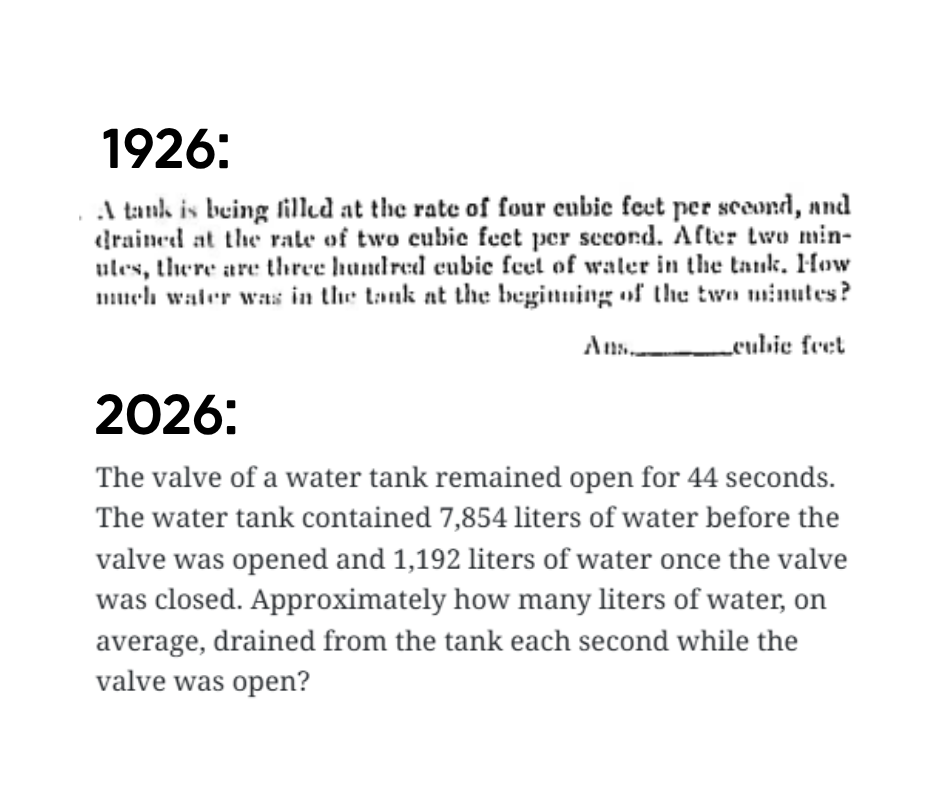
Some things hadn’t changed that much. I was stunned to read the following question, which was eerily similar to a practice test question I worked through regularly:
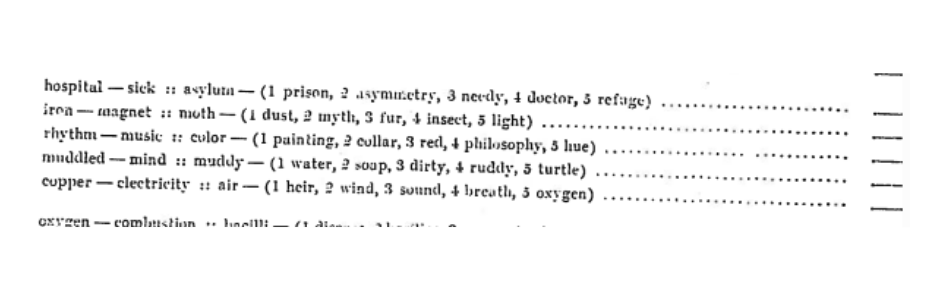
Testing categories have certainly changed, sometimes immediately and sometimes after years of lingering. The SAT tested analogies (seen below) from the beginning. Analogies were finally dropped from the SAT in 2005.
One question type that was removed almost immediately was called Artificial Language. Artificial Language introduced a student to a nonsense language, told them the rules to the language (example: “future time is expressed by placing “bel” before the verb”), and asked testers to translate English into this language and vice versa for individual sentences. After trying a few examples, I know that practice really did make progress on those questions. This question type was dropped after only two years.
Despite the significant differences between 1926 and 2026, as a test prep tutor, the test felt familiar. Many questions were connected to questions students see today. The SAT continues to be used by many college admissions officers. A test score can be a good indicator whether an applicant is likely to be successful at their school.
The test remains imperfect but the testmakers are committed to making sure the “SAT questions are carefully developed and rigorously reviewed for evidence of bias and any question that could favor one group over another is discarded.” (link to CollegeBoard statement) The SAT spends over a million dollars developing each test– the 1926 report alludes to “the cost of creating diagnostic tests of this type quickly runs into the thousands of dollars.” As of this post, $1500 in 1926 had the buying power of $28,222 today. It’s come a long way from the initial 8,040 testers.
World Class Tutoring is always looking to the present and future of the tests. As a history major, I enjoyed looking back. If you have questions about the tests, please send us an email or book a call!
You can take the whole 1926 test here: https://cognitivemetrics.com/test/1926-SAT/AL
