
I have helped hundreds of students with ACT test tips. Actually taking the test, however, is different from kicking back doing practice sections for homework. I want to know everything about what a student could encounter in testing. So? 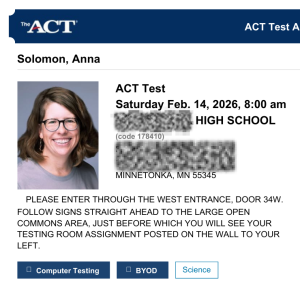 I registered to take the February 2026 Digital ACT. I am able to test despite being a test prep professional due to the partnership between the ACT and my professional organization, the National Test Prep Association, where I am a founding member and serving board member.
I wanted to see the latest test structure and to experience test day, both from the student perspective but also as a digital test taker. These are my experiences, thoughts, and takeaways.
Before Test Day
ACT did a great job communicating via email! I was sent many emails from the ACT to make sure I ran the required software on my laptop. ACT emailed an easy to follow list of items to bring, including a printed out test ticket. They specifically said NOT to depend on a phone screenshot. I ended up using that ticket as scratch paper.
Test Day
The morning of the test, I realized I didn’t have any wooden pencils in my house. I had a mechanical pencil and a pen but hadn’t thought of the pencil since I wasn’t manually filling in a bubble sheet, so maybe I could have just used a pen, but it was stress I didn’t need! So here’s your first ACT test tip: Follow the list, kids! The proctor had extra pencils, so I used one of those and retuned to calm.
Walking into the building, I easily saw signage up for the door to use and the hallways. I did initially miss that our classroom assignments were printed out in the main hall. No one checked my information until I entered my room, where the proctor checked my printed out ticket and my ID. He handed me another paper that had the start code and my assigned seat number. A student did not check in with him first and sat at an unassigned desk, which slowed down beginning testing.
Starting the first few sections was rocky. The posted test start time was 8am, but we were not actively testing until 8:20, and the room was dead silent. I’ve heard from another tutor that her test was an hour behind, so be prepared to hurry up and wait!
The proctor said to read the instructions and then press next, but then there was another screen of instructions. The clock had already begun to count down, but many students waited for the proctor to say “go” and lost at least 30 seconds.
English
Concepts
- It vs they
- Modifiers
- Redundancy
- Complete thought at end of sentence
- All and each as subjects of verbs
- Idiom: “close to full” vs “closed to full”
What did I think about the ACT English section?
I had a hard time reading the passages and ultimately answered questions just by looking at the relevant sentences. I did not feel like I had a good grasp of the storylines but didn’t need to. There were a lot of writing style questions: redundancy, match the tone, match the structure, and “key word” (which is most clear, which is most emphatic). There are probably more useful ACT test tips in the English section than any other, so make sure you study ACT grammar rules.
Did digital annotation tools help in ACT English?
I used the answer elimination tool (which I had to set up through the “tools” button) throughout and marked/flagged a few to review. Ultimately I had about 6 minutes at the end and used that time to scroll through to see the question types. There was a tool called “filter” on the right side that was great– you could filter for just unanswered or flagged questions, and it would take you right to them, leaving the filter list up while also showing the text and question. The list updated immediately for “unanswered questions” if you picked an answer with it open.
I also like having the text highlighted by the test where the grammar questions were located. No searching, especially if they were asking about multiple sentences/placement. This is very useful since I’ve had students misunderstand or not be able to find the relevant part of the passage.
Takeaways: ACT Test Tips for English
- Use the annotation tools available if they help you.
- If you are taking the digital test, practice with at least one digital test online. You don’t want to learn the platform on test day.
- Read the instructions during prep so you don’t have to on test day. Press the “next” button if it’s available. The proctor will not say “go.”
Math
Concepts
- Identify inverse equation when given points, none had opposite reciprocal slope
- Comparing volumes of cylinders
- Arc measure when inscribed angle is known
- Probability with samples
- Vectors, using a and b instead of (x,y)
- Expected value
- Only had scientific calculator available– desmos glitch!! Other students had desmos
What did I think about the ACT Math section?
I definitely missed the old ACT structure of 15 “easy” questions to start. I began fighting for my life around question 7– another tutor who tested but took a different test said question 1 was difficult. There were many “one-off” questions, meaning concepts that are only tested for one question but if you aren’t familiar with the concept, you’re unlikely to answer correctly. The ACT used to give brief explanations of these concepts but they didn’t on this test.
A few students in my room had technical issues with this section. Two of the three were able to continue, but one student’s math section hadn’t submitted when the proctor closed the room for break, and the student ended up leaving the test.
There was no formula sheet given in the math section, so make sure you’ve got all the needed formulas memorized. Rather than giving you a list of ACT test tips, I can share link you to the full list here: Formula Sheet for the ACT
Did digital annotation tools help in ACT Math?
No. Testing in the digital format did not affect my ability to work through the section, either helping or hurting. Unfortunately I did experience a platform glitch: I was only able to access a scientific calculator, not the Desmos graphing calculator. Later I asked around and found out other students had Desmos. My proctor suggested that it changed by question, which horrified me in the moment (had I missed a chance to use it, I thought??) and was definitely incorrect. I found out later there was a tech glitch and other students experienced it– after emailing ACT support, I was offered a free retake.
I used three sheets of paper (one sided) and kept my work organized by writing and circling the question number, then moving on to the next “line.”
Takeaways: ACT Test Tips for Math
- Prepare for something to go wrong with digital testing. I was grateful to have brought my TI83-Plus and TI30X calculators.
- Study any unfamiliar math concepts you see in previous ACTs. They are on the current enhanced practice tests, but if you have access to previous legacy tests look at questions 40-60 for one-off concepts.
Reading
Concepts
- Passages: Moose vs horses, algae mats, radio transmissions/aliens, painter Vassalli
- First passage 2 or 3 questions talking about literal vs figurative
- Many retrieval questions, often matching key words
- Paired passage was easy to do– I naturally read only the first passage and answered the questions, then read the other

One passage was about moose and how they move. Don’t let a moose sneak up on you!
What did I think about the ACT Reading section?
I had trouble scrolling and reading the passage. I ended up taking notes on my scratch paper of the general idea of each paragraph and then relying on the answers being nearby. If a question referenced a particular part of the passage, that passage was automatically scrolled to (though I often had to scroll down a little for context).
Did digital annotation tools help in ACT Reading?
Yes. Using the annotation tools is one of my many ACT test tips. I used the answer elimination and highlighter annotation tools the same way I would have used my pencil on a paper test. I used my scratch paper to write the main ideas of paragraphs. On the paper test I write those notes to the side of the passage.
Takeaways: ACT Test Tips for Reading
- Use the tools that help you
- Use your scratch paper if it helps. I think I was the only one writing on it for this section, and I had to get up to get another sheet– do what you need to do!
Science
Concepts
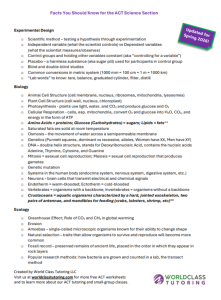
- Molecular structure
- 2 student perspective (Student 1, Student 2, etc) passages
- No clear transition to next passage
- Topics: coffee with ph and NAOH, laser with structure drawn, electrons transferred by cloth rubbed with wool, burrowed dirt and is a crab a crustacean
There are traditionally at least three outside knowledge questions on the ACT– science facts you have to know that are not given within the passage. That isn’t a lot, and in the past they have been middle school level science, but I would definitely review what has been tested in the past.
Everyone who didn’t sign up for science did the writing so no one left the room after section 3. Science and writing are the same length.
What did I think about the ACT science section?
I left five blank, so I made a huge mistake on timing! A was my go-to answer. I found science very difficult to do after being so used to paper– I couldn’t see all the questions so I didn’t have a sense of when I was moving from the early easy retrieval questions at the start of the passage questions to later, more difficult questions later in the passage. At least one time I didn’t realize I’d moved on to the next passage and the question being about coffee threw me.
One test strategy for ACT science that I recommend for students is to prioritize doing the earlier questions (there are usually around five, so focusing on the first two or three) and moving on to the next passage to get the next set of easy questions. If I test digitally again, I will use my scratch paper to keep track of the organization of questions. That way I’ll have a better sense of when the questions switch to the next passage and I can prioritize better.
I spent too long trying to understand some passages and definitely missed being able to draw on the graphs. I used the highlighter to mark key words in questions and wish I’d done that earlier, but not being able to mark the graphs was hard– I used my finger and wrote on my scratch paper to keep track of relationships.
Did digital annotation tools help in ACT Science?
The help wasn’t worth the price. I wasn’t able to annotate the graphs, only the text. I did use the answer eliminator to help me use process of elimination, as I often do on science sections. Having the science section in digital format was much more difficult for me to process. World Class Tutoring will continue to recommend taking the paper test for this section specifically.
Takeaways: ACT Test Tips for Science
- Practice doing the science section on the platform you will use. Use scratch paper if you are testing digitally and won’t be able to annotate the graphs (I tried– you can’t).
- Keep track of time and go in with a prioritization plan. I ended up guessing on most of the last passage, which is not likely to be an unscored field test passage. If I’d known I might run out of time, I would have prioritized getting to that passage before one of the middle ones in order to maximize my score.
I’d love to hear from other test-takers on your ACT test tips! Please don’t discuss specific questions. There were at least four different tests used in this iteration, even in the same testing room. Did my experience surprise you? What were your takeaways? I welcome your comments!
