
College Board released SAT Practice Test 11 in the Bluebook app in early February 2026, making it the newest official practice test available. If you’re preparing for an upcoming SAT, this is the one you should be doing right now. I took it myself a few weeks ago, and here’s what I found.
SAT Practice Test 11: A Tutor’s Take
The SAT is a fair test that does a good job of assessing the skills of reading, writing, and math. After all, would our most competitive universities still be using it to make such important decisions if the results weren’t reliable? Plus, studying for the SAT is worth your time for more reasons than getting in to your dream school. The skills the SAT tests, including careful reading, precise reasoning, solid grammar, mathematical thinking, and test taking strategies, are skills that will genuinely serve you in college. Finally, I want to assure you that studying works. Most of my students who put in a serious effort will improve their scores by 150-250 points, and sometimes even more. This is why 2 decades after graduating from my alma mater, Lehigh University, I’m still studying the SAT myself!
Since the SAT went fully digital for U.S. students in March 2024, I’ve been watching it evolve. What I’ve noticed is that it’s getting more difficult, especially in Reading and Writing. When I took Practice Test 11 last week, I decided this newest test continues that trend.
Reading and Writing
I want to organize my observations the same way the test is organized, so let’s go section by section.
Vocabulary
The vocabulary on SAT Practice Test 11 was challenging but manageable. You’ll see solid academic words (this test included critique, exploit, hamper, incongruous, pretentious, shrewd, ubiquitous, homogenous, and fecundity). These aren’t words that will stop you cold, but you do need to know them. The best way to approach vocabulary on the SAT is to read, read, read rather than memorizing lists. This will give you a sense of how the words are used in context rather than just a memorized definition.
Reading Comprehension
The literature passages on Practice Test 11 were significantly easier than the science ones, with one exception: there was a Shakespeare passage that was genuinely weird and threw me off.
The science passages are where things got hard, mostly because the topics were so specific that they were all unfamiliar to me. But the trick is to not get caught up in the specific words for that topic and instead home in on the phrases that signal relationships between ideas. I call these signal words, and they show up in every science passage regardless of the topic.
After 20 years of studying for the SAT, these words jump right out at me as being the keys that unlock the correct answer. Here are some examples I noticed on Practice Test 11, organized by type.
Causation: cause, effect, attributable/attribute/attributed, influences, mediate, constrain, conditions, sensitive, implication
Hypothesis: hypothesizing, predicting, assumed, likely
Methodology: observed, tagged, recorded, accurately captured, assessments, simulated, modeled
Conclusions: suggesting, implication, concluded, indicative, asserted
Comparisons (Directional difference): more/less, larger/smaller, stronger/weaker, increasing/decreasing, predominant, exceed, positive or negative correlations
Comparisons (Difference without direction): marginally different, significant change, important impact, substantial effect, notable difference, varies, range, discrepant, disagreement, associated, correlated
Comparisons (Same): similar, homogenous, equal, uniform, track closely
Size and Scope: reliable, sparse, various, across cultures, negligible, relatively low degree, limited effect, primary, essential, pure, ubiquitous, transient, brief, retain, responded, across cultures, critical threshold
The command of evidence questions, especially the ones with charts and graphs, were actually less intense on Practice Test 11 than on some recent tests I’ve reviewed. If those have been your weak spot, you can breathe a little easier on this one.
Where I found the real difficulty was in the inference questions. These were harder to think through than on any comparable test I’ve seen recently. The issue wasn’t vocabulary or grammar. It was following a complex chain of logic. Unlike authors who want you to understand their writing, the evil geniuses who write the SAT work hard to be technically correct but effectively confusing. I approach these by defining the variables and working through the cause-and-effect relationships.
One more thing: some of my students have reported noticing longer questions and answer choices on their official SATs. I didn’t notice that on Practice Test 11, so keep that in mind as you use this practice test.
Grammar
There were 11 grammar questions across both modules, appearing around question 15. Here’s what I saw:
- 3 introductory modifying phrase questions
- 2 subject-verb agreement questions
- 2 verb tense or verbal questions
- 3 punctuation questions
- 1 profession/proper name question
For all grammar questions, my advice is to read the options first. Here’s why: sometimes you can answer the question completely before you even read the sentence. That happened to me twice on this test. Other times, reading the options first lets you eliminate choices right away. For example, if you see a period and a semicolon as two of the options, you can eliminate both of them immediately because they’re interchangeable. And even when you can’t eliminate anything, reading the options first tells you exactly what the question is assessing.
That said, always read the sentence, even if you are 99% sure of the correct answer just from the options. I’m not here to give you bad habits. Taking the SAT is the time to be smart, not lazy.
A few specific things to know about question types you’ll see:
Three introductory modifying phrase questions is a lot. I have a worksheet specifically on this skill that will help you notice the pattern behind them. Once you get the idea, you’ll find these quick and easy.
The profession/proper name question gives you a professional title and a person’s name (such as SAT tutor Heather Krey), and the options differ only in where commas are placed. The answer is always the version with no commas around the name.
For subject-verb agreement, one of the Practice Test 11 questions had a verbal distractor that made it harder to predict the answer before reading. The other was completely predictable just from the options. Either way, your strategy is the same: identify the subject, determine whether it’s singular or plural, and match your verb accordingly. Remember that the object of a preposition can never be the subject of a sentence because the SAT loves to put a long prepositional phrase between the subject and the verb to trip you up. I have another worksheet here to help you with the subject-verb agreement questions.
For punctuation, watch for the period/semicolon situation I mentioned above. If you see both as options, cross them both off immediately and focus on the remaining two. You can check out my comma splices mini lesson to build your skill for this question type.
Transitions
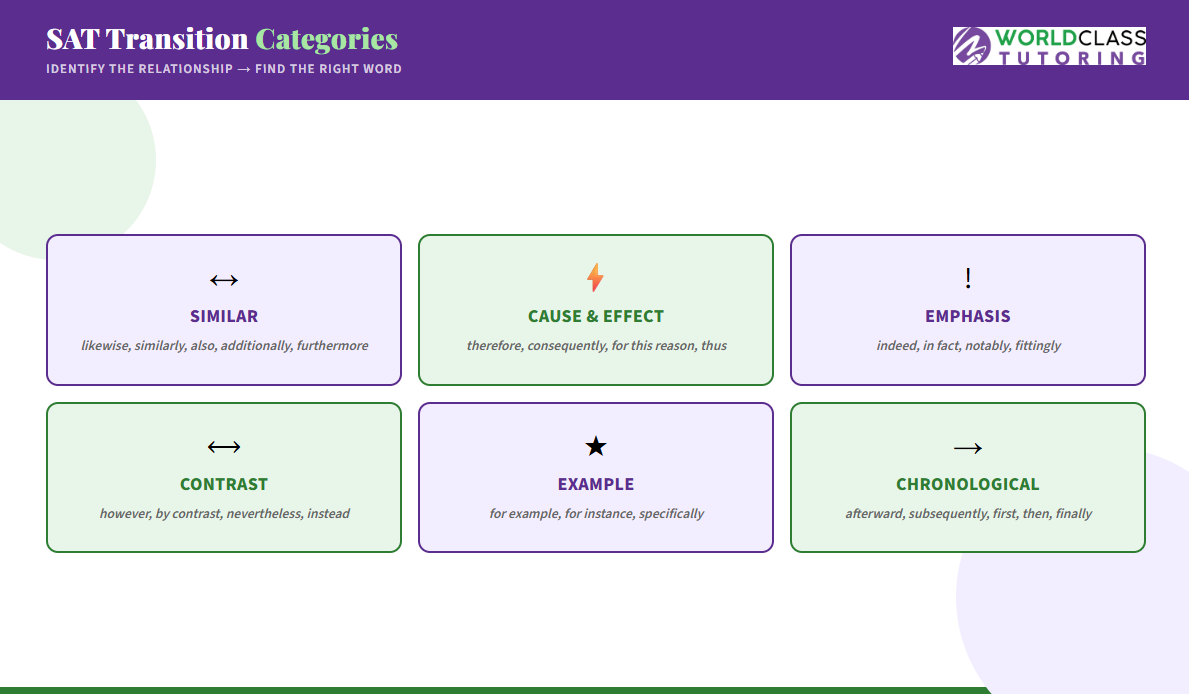
After the grammar questions come a handful of transition questions. The familiar ones were all there: though, for example (which appeared three times), likewise, additionally, nevertheless (historically the most popular transition word on the SAT), by contrast, afterward, instead, specifically, consequently, fittingly, for this reason, more often, and in conclusion.
What was unusual were four longer transition phrases: contrary to this phenomenon, undermining this explanation, drawing a similar conclusion, and confirming this hypothesis. Three-word transition phrases aren’t typical on the SAT, but the approach is exactly the same.
For every transition question, your job is to identify the relationship between the sentences. I like to think in these categories: similar, same, cause and effect, emphasis, contrast, example, conclusion, and chronological order. Once you’ve named the relationship, find the transition word that matches that category.
On the harder transition questions, you’ll notice there are actually two relationships happening in the passage, and you have to figure out which one belongs at the location of the blank. That’s where students get tripped up. Don’t just find any relationship — find the one that belongs there.
Rhetorical Synthesis
As always, SAT Practice Test 11 finished up with a handful of Rhetorical Synthesis questions. Sometimes referred to as “student notes”, these questions give you a set of bullet points and ask you to use the information to accomplish a specific purpose. PT11 had four of these questions in each module.
The most important thing to know about these questions is that the signal phrase is always in the question stem. The question will tell you exactly what you need to do: explain historical context, specify the order, emphasize a difference, make and support a claim, and so on. That signal phrase is always necessary, and reading the bullets is only sometimes needed.
On PT11, the questions got harder from first to last, and the bullet points became more important as you went on. In Module 1, two of the four questions didn’t require me to read the bullets carefully at all. The other two required me to use the bullets to distinguish between two answer choices. In Module 2, all four questions required careful attention to the bullets. Three of them required the bullets to distinguish between two options, and the last question required me to use the bullets to distinguish between all four answer choices. On top of that, I needed a definition from one bullet point to make sense of the information in another. That’s a level of complexity I haven’t seen often on these questions.
So here’s my advice: as you move toward the end of the module, plan to spend more time on the bullet points. Don’t assume you can answer from the question stem alone. And always, always start with the signal phrase.
Math
Math on Practice Test 11 felt consistent with the previous practice tests on bluebook. If you’ve been preparing well, there shouldn’t be any big surprises. That said, there are some specific things worth knowing before you sit down with this test.
I recently presented a full SAT deconstruction of Practice Test 11 at a training event for the National Test Prep Association (NTPA), where I walked through both math modules with fellow tutors. One of the biggest takeaways from that session was how many questions reward students who have practiced using Desmos. Many students think Desmos can be ignored if they already have a graphing calculator, but they are leaving major points on the table if they make that mistake. There are lots of creative ways to use Desmos that go way beyond graphing.
Desmos
I used Desmos on about a third of the questions — 14 out of 44 to be exact. If you’re new to Desmos or want to sharpen your skills, I have two YouTube videos that will help: Desmos Drill 1 covers the basics, and Desmos Drill 3 covers regression specifically. I’d recommend watching both before you take PT11.
That said, Desmos is a tool, not a crutch. Question 2 in Module 2 is a perfect example of what I mean. The question gives you a system of equations.
You can absolutely graph both equations in Desmos and find where they intersect, which is a perfectly good strategy. But if you notice a shortcut, you can solve it even faster. Both equations have an x, so if you subtract one equation from the other, x cancels out entirely, and you’re left with the value of y. That’s it. This is a great example of a problem where Desmos is good, but thinking is better.
The most important Desmos skill on this test was regression. I ran a custom regression five times across both modules. If you don’t know how to enter data into a table in Desmos and use a tilde (~) to fit a custom equation to that data, you need to learn it before test day. Desmos Drill 3 will walk you through exactly how to do it.
Topics and Observations
The test covered the usual range of topics: linear equations, systems of equations, quadratic equations, exponential functions, inequalities, scatterplots, probability, mean and median, unit conversion, angle relationships, similar triangles, surface area, radicals, proportions, and the equation of a circle. Make sure you have all the key formulas memorized. I have a free SAT formula sheet you can download and study.
Probability and statistics appeared more than on previous tests. If you’ve been skipping those topics in your prep, don’t. They showed up, and they mattered.
There was only one percentage question — and it was brutally hard. I know this because I got it wrong, and I’ve been doing SAT prep for 20 years. The trap was as old as they come: when I converted a decimal to a percentage, I moved the decimal two places in the wrong direction. What made this trap so effective is that moving the decimal the wrong way gave me a prettier, more satisfying answer. The SAT is very good at making the wrong answer feel right.
A unit conversion trap in Module 2 involves a scale model where 1 inch equals a certain number of feet in the actual building. The trap is that some of the wrong answers incorporate the number 12, nudging you to also convert between inches and feet. But if you read carefully, you’ll notice the given conversion factor already accounts for the unit change. You don’t need the 12. Don’t let the wrong answer choices make you second-guess what you already know how to do!
The square unit conversion trap also made another appearance. This is a continuing pattern on the SAT. When you’re given a conversion factor for linear units but asked to convert between square units, you have to square the conversion factor. If you forget to do that, you’ll get a wrong answer every time.
Surface area appeared again as a high-difficulty question. This has been a consistent pattern across recent SATs. Make sure you know how to calculate surface area for a right rectangular prism (aka a box).
The Root-Factor Connection
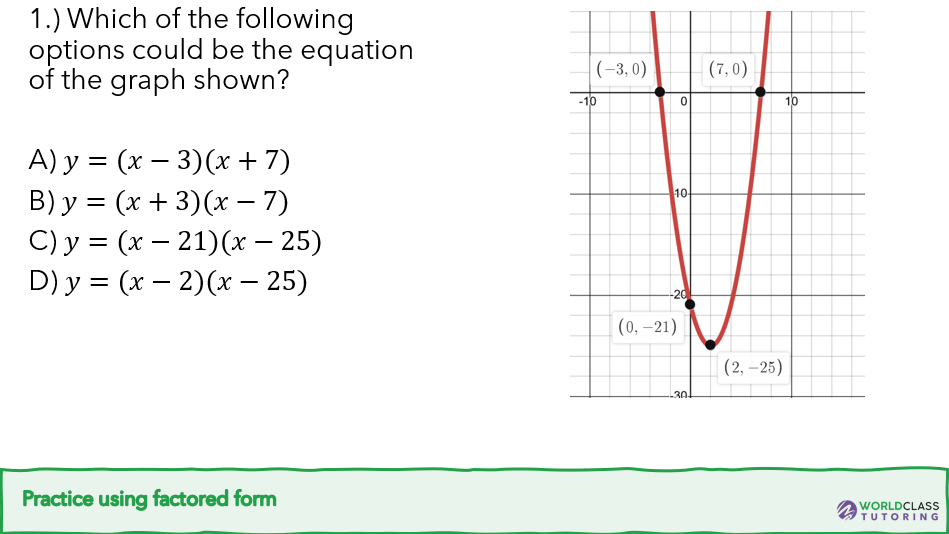
I want to flag one specific question because it illustrates something important. The second-to-last question on Module 2 showed a graph of a function and then gave you an equation of that function after a transformation. I got it wrong because I forgot to account for the transformation. I read the question too fast and paid for it.
The underlying skill being tested is what I call the root-factor connection: the ability to look at the x-intercepts on a graph and connect them directly to the factors in the equation. If you see an x-intercept at x = -3, the corresponding factor in the equation is (x + 3). In other words, you flip the sign. Once you get the hang of it, it starts to feel quick and easy, but it takes years of math classes to get to that point. This is a skill students really master in pre-calculus, and it’s critical for a high score on the SAT.
But this one particular question was about more than the root-factor connection. You also had to take the horizontal translation into account. It’s about reading carefully. The transformation was right there in the problem. I just missed it.
The Bottom Line
SAT Practice Test 11 is the most difficult and the most realistic official practice test currently available. However, it’s a fair test, and preparation makes a real difference. The students I work with who put in a solid effort for a few months see an impressive improvement in their scores, and they show up to college better prepared because of it.
Start by downloading Bluebook and taking PT11 under real test conditions. Then use the observations in this post to guide your review. For more free SAT practice and resources, visit our free practice page, and check out the World Class Tutoring YouTube channel for videos on grammar, math, and Desmos strategy. If you want structured guidance working through material like this, I teach weekly live SAT classes over Zoom and work with students in private tutoring sessions as well. You can find out more at worldclasstutoring.com.
